
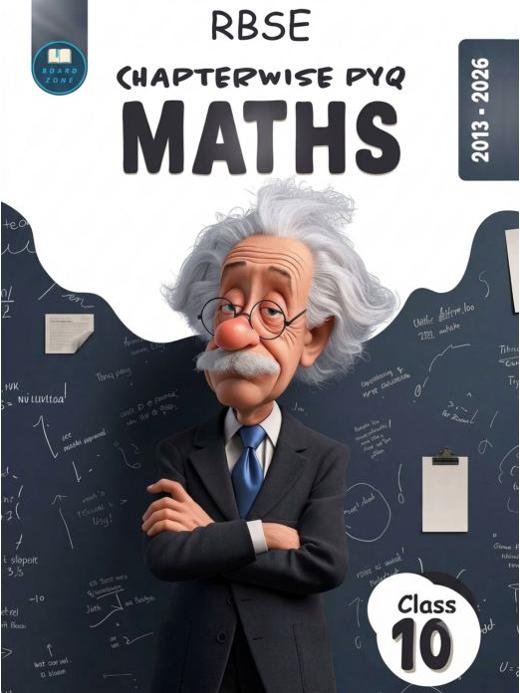




About This Maths PYQ Book
RBSE Class 10 Maths Chapter-wise Previous Year Questions PDF (2013–2026)
If you're serious about scoring well in the RBSE Class 10 board exam, chapter-wise previous year questions (PYQs) are the fastest and most reliable path to a high score. This is not another sample-paper collection — this is 13+ years of actual RBSE Class 10 Maths board questions (2013 to 2026), sorted chapter-by-chapter, section-by-section, in both Hindi and English medium.
One download. All 14 chapters. Every question tagged with the year it appeared and the marks it carried.Available at a discounted price. Chapter 1 is completely free — no signup, no email, just download and see the quality yourself.
Why This Book is Different from Every Other RBSE PYQ Book
Most PYQ books throw questions at you in random order or by year. That's fine if you want to attempt one full paper, but terrible if you want to actually learn patterns.
Here's what happens with the chapter-wise approach: when you sit with 13 years of Quadratic Equations questions stacked together, patterns appear in 15 minutes. You spot which factorisation types repeat (RBSE has asked x² – 8x – 180 = 0 verbatim). You notice boat-and-stream word problems keep coming back (2015, 2017, 2022). You see "Prove √2 is irrational" appears in 2015, 2016, 2017, 2019, and 2024 — five years out of thirteen. That's not coincidence. That's a pattern only chapter-wise revision reveals.
This book was made because our team saw students waste months solving full papers when they could have mastered the same content in weeks with the right structure. Every question inside is tagged with (RBSE 2019), (RBSE 2024), and the marks in square brackets like [3M] — so you know instantly what you're looking at.
Section-wise Structure (Matches the Real Board Paper Exactly)
The RBSE Class 10 Maths paper is 80 marks and follows this section structure — and so does this book:
| Section | Question Type | Marks per Question | Purpose |
|---|---|---|---|
| Section A | MCQ + Fill in the Blanks + Very Short Answer | 1 mark | Quick recall, definitions |
| Section B | Short Answer | 2 marks | One-step calculations, small proofs |
| Section C | Long Answer | 3 marks | Multi-step problems, standard proofs |
| Section D | Very Long Answer | 4M / 5M / 6M | Word problems, graphical solutions, theorem proofs |
By practising in the exact same section format the board uses, you develop timing naturally. When you write the actual exam, you already know how long to spend on each section.
All 14 Chapters — What's Covered
Here's every chapter in the PDF, mapped to the current Rationalised NCERT syllabus, with the actual question patterns RBSE has repeated over the years.
- Real Numbers (वास्तविक संख्याएँ) — HCF/LCM by prime factorisation, sum of powers of prime factors, irrationality proofs (√2, √3, √5, √6, 7√5)
- Polynomials (बहुपद) — zeros of a polynomial, sum and product of zeros, forming a polynomial from given zeros
- Pair of Linear Equations in Two Variables (दो चर वाले रैखिक समीकरण युग्म) — graphical method (very repeated as 6M), elimination, substitution, taxi-fare and cost problems
- Quadratic Equations (द्विघात समीकरण) — factorisation, discriminant, nature of roots, boat/stream, train speed, rectangular field problems
- Arithmetic Progressions (समांतर श्रेढ़ियाँ) — nth term, sum of n terms, traffic-signal word problems (asked in 2016, 2017, 2019)
- Triangles (त्रिभुज) — Basic Proportionality Theorem (BPT), similarity criteria, Pythagoras theorem
- Coordinate Geometry (निर्देशांक ज्यामिति) — distance formula, section formula, midpoint, collinearity, quadrilateral type
- Introduction to Trigonometry (त्रिकोणमिति का परिचय) — ratios, standard angle values, prove-based identities (repeated heavily as 6M in Section D)
- Some Applications of Trigonometry (त्रिकोणमिति के कुछ अनुप्रयोग) — heights and distances, tower/tree/pole problems, angles of elevation and depression
- Circles (वृत्त) — tangent properties, tangents from external point, cyclic quadrilateral theorems
- Areas Related to Circles (वृत्तों से संबंधित क्षेत्रफल) — sector area, segment area, CCTV camera / grassland / horse-grazing problems
- Surface Areas and Volumes (पृष्ठीय क्षेत्रफल और आयतन) — combinations of solids (hemisphere + cylinder, cuboid + cones)
- Statistics (सांख्यिकी) — mean, median, mode of grouped data, step-deviation method, missing frequency
- Probability (प्रायिकता) — dice, cards, marbles, balls-from-bag, coin toss problems
RBSE Class 10 Maths Marking Scheme 2025-26
| Unit | Chapters | Approx. Marks |
|---|---|---|
| Number System | Real Numbers | 6 |
| Algebra | Polynomials, Linear Equations, Quadratic Equations, AP | 20 |
| Coordinate Geometry | Coordinate Geometry | 6 |
| Geometry | Triangles, Circles | 15 |
| Trigonometry | Introduction, Applications | 12 |
| Mensuration | Areas Related to Circles, Surface Areas & Volumes | 10 |
| Statistics & Probability | Statistics, Probability | 11 |
Just four units — Algebra + Geometry + Trigonometry + Statistics & Probability — cover 58 out of 80 marks. Master these chapter-wise with PYQs, and a first-division score is comfortably within reach.
Repeated Questions You Cannot Miss
Some questions in the RBSE Class 10 Maths paper have literally been asked multiple times across different years. This book marks all of them. Examples pulled directly from the PDF:
- "Prove that √5 is an irrational number" — RBSE 2019, RBSE 2024
- "Find the HCF of 95 and 152" — RBSE 2023, RBSE 2024
- "Solve the pair of linear equations x + y = 14 and x – y = 4" — RBSE 2023, RBSE 2024
- "If 18, a, b, –3 are in AP, find a + b" — RBSE 2023, RBSE 2024
- "Find two consecutive positive integers whose sum of squares is 365" — RBSE 2024, RBSE 2025
- "Prove √(1+cos A / 1–cos A) = cosec A + cot A" — RBSE 2014, RBSE 2018
- "If from a point 100 m from the tower foot, elevation is 60°, find the tower's height" — RBSE 2021, RBSE 2024
- "The shadow of a tower increases by 40 m when the Sun's altitude changes from 60° to 30° — find the tower's height" — RBSE 2013, RBSE 2023, RBSE 2026 (three times!)
If you skip these, you're leaving guaranteed marks on the table.
Which Chapters Give You the Highest Return on Time?
If your prep time is short, prioritise chapters in this order:
- Algebra (~20 marks) — Polynomials, Linear Equations, Quadratic Equations, AP
- Geometry (~15 marks) — Triangles, Circles
- Trigonometry (~12 marks) — Both chapters
- Statistics & Probability (~11 marks) — Formula-driven, quick to master
Focus chapter-wise PYQs on these four units and you cover 58 out of 80 marks before you even touch Coordinate Geometry or Mensuration.


Leave a Review